


Welcome to a short history of Britain and the British. A few caveats:
I’m not a historian; I wasn’t allowed to do my history GCSE so as not to bring down the school’s average grades.
This is in no way comprehensive; it’s an attempt to pick out some defining characteristics of these isles and their people.
I haven’t drawn any conclusions, yet; this series is a genuine attempt to figure out who we are and why we are—using only a tiny set of skills (the internet and a little bit of critical thinking).
So here goes. We start where all good things start, Norfolk…
Our story begins around 900,000 years before what we now call the Common Era (CE), but used to be called BC (Before Christ) – and this change will be important later on - we will use BCE and CE so as not to confuse things.
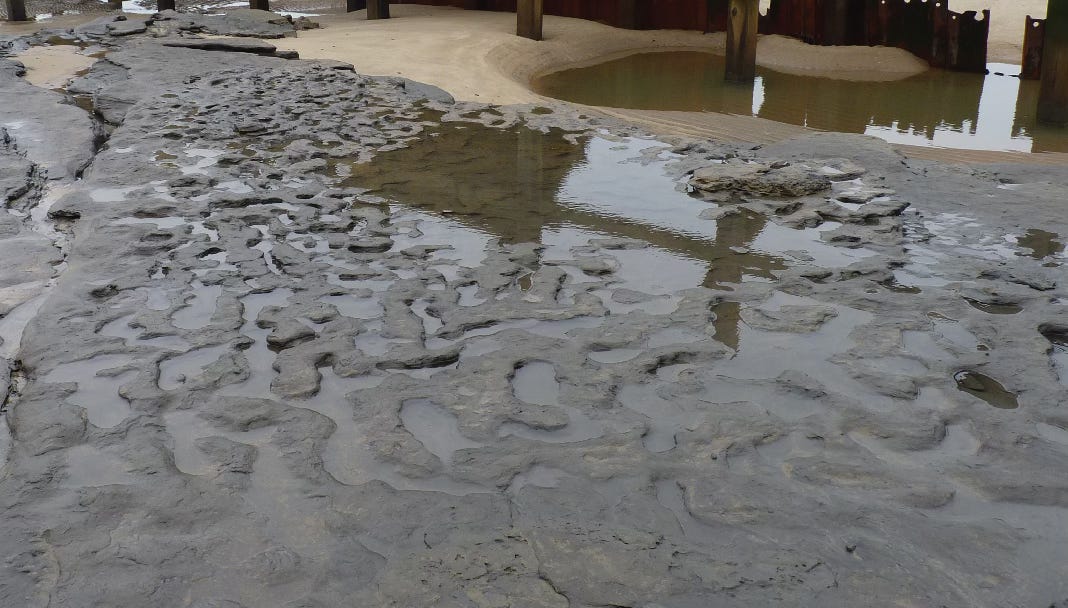
Somewhere between 900,000 and 700,000 BCE we see the first signs of early humans, or hominins as scientists call them, in a place called Happisburgh (pronounced Haysborough) – because the English language would be no fun if things were pronounced the way they were written – in Norfolk. Footprints found in estuary mud are the oldest outside Africa and give us our first glimpse of our ancestors. Unfortunately, despite spreading out as far as West Sussex, our ancestors did not last long on this island; an ice age turned Britain into a cold and unforgiving desert, so they retreated to the European mainland (because you could then, as there was no English Channel).
Then about 450,000 BCE there was a massive flood as the Earth warmed. A vast ice-dammed lake in the southern North Sea, fed by melt-water from ice sheets and rivers such as the Rhine and Thames, rose high enough to overtop the 600-ft Weald–Artois chalk ridge; the resulting outburst megaflood scoured the ridge away and opened the Dover Strait.
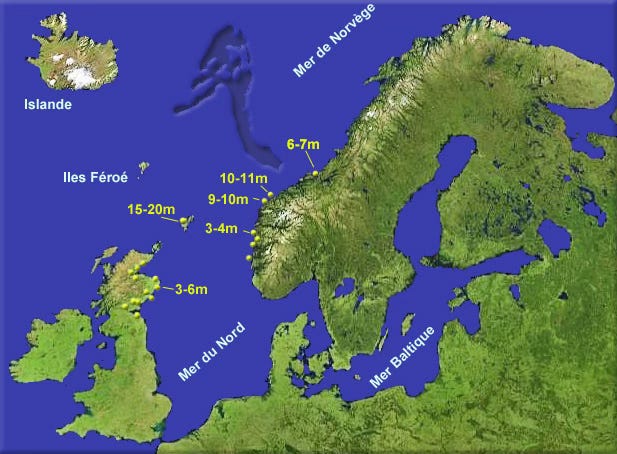
From the end of the Anglian glaciation (~424,000 BCE), humans repeatedly recolonised Britain during each interglacial, walking across the Doggerland land bridge, only to be pushed out – or reduced to tiny groups – when ice sheets returned. Continuous settlement began after the last ice age (~12,000 years ago), and Britain became a true island when Doggerland finally drowned under post-glacial sea-level rise, its last lowlands swept away by the Storegga Slide tsunami (~6200 BCE).
And then it all goes quiet for a bit, geologically speaking, which must have been a bit of a relief for our ancestors, allowing them some time to live on their newly created island.
We rejoin our story around 4000 BCE where we find mostly small kin groups descended from Anatolia-origin farmers originally from around the Agean, who made their way up the Atlantic coast and then crossed the Strait of Dover in timber or hide-covered boats. They had been farming for about 3,000 years already, so brought not only technique, but domesticated wheat, barley, sheep, goats, cattle and pigs, along with pottery-making and polished stone axes.
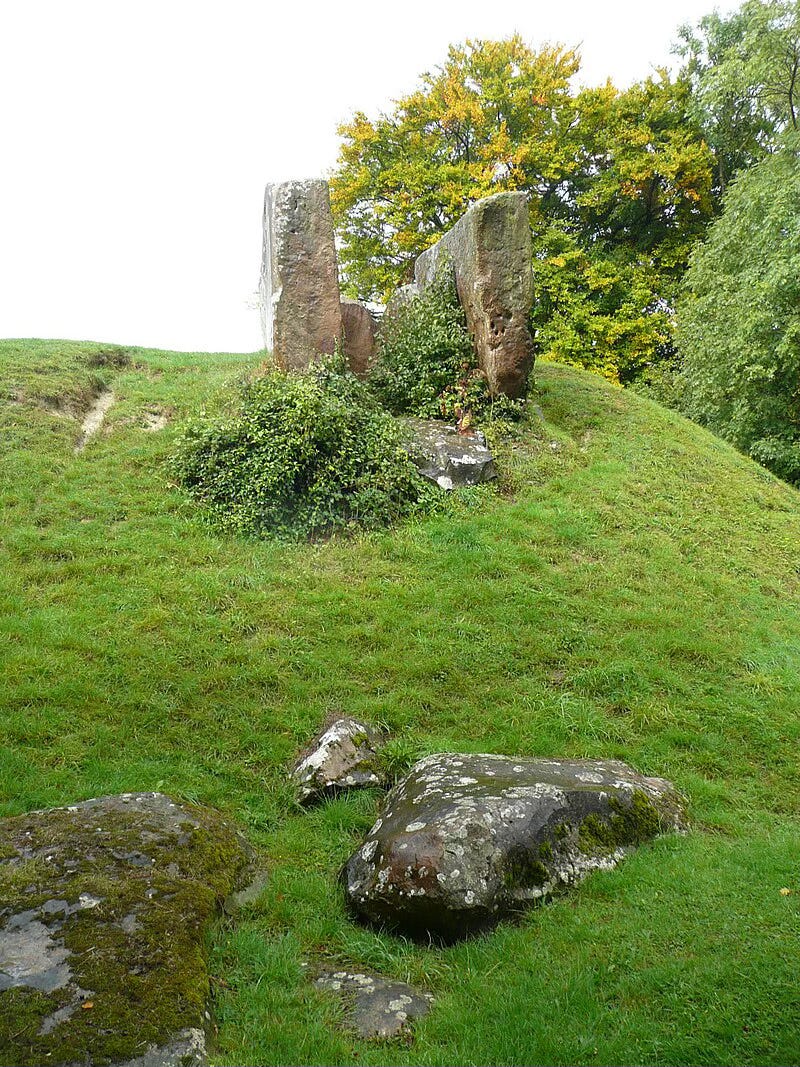
We see for the first time a monumental, communal treatment of the dead in the shape of Long Barrows. Another new practice is the introduction of architectural season-watching, although we’d already seen some evidence that our ancestors observed and understood the seasons (at Warren Field in Aberdeenshire (~8000 BCE) hunter-gatherers dug a 12-pit lunisolar “calendar” aligned on the mid-winter sunrise – the oldest known seasonal reckoner in the world). This period, probably because they depended on sowing and harvest dates that meant they had to be really aware of the seasons, they started building monumental alignments (monumental in the literal sense, not because they were massively awesome), and from there, gatherings started and became festivals where communities came together to feast, trade and bond, and these became rituals whose echoes we still see today.
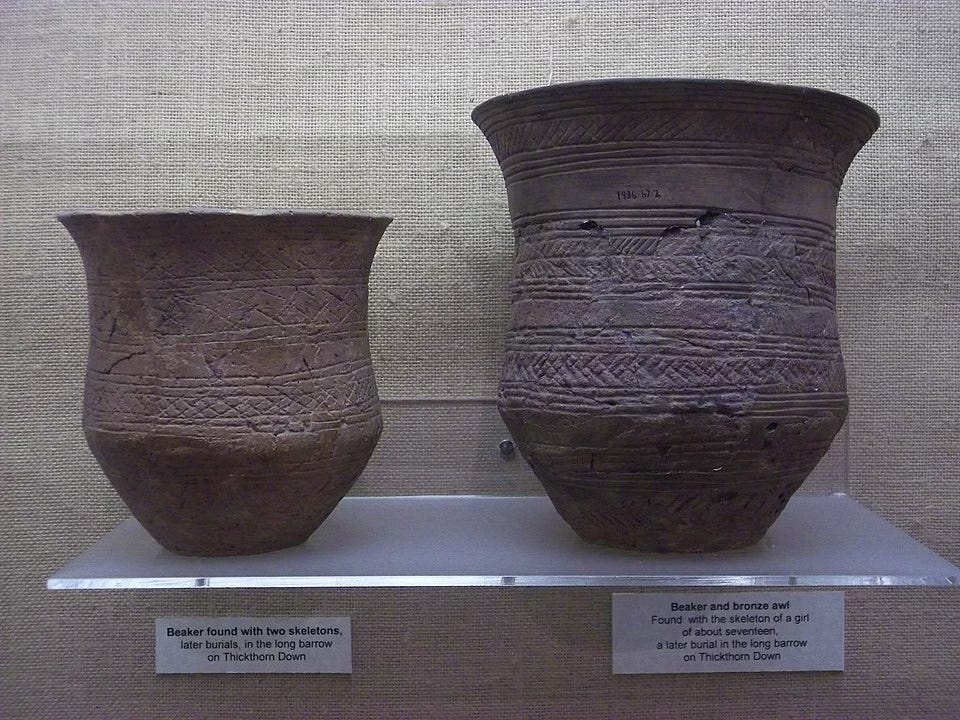
These farmers seem to have lived quite happily for the next fourteen centuries until around 2600 BCE when we see the arrival of the Bell Beaker people who came up from the Rhine area, but whose DNA is from an even earlier migration from the Pontic-Caspian steppe – the open plains north of the Black and Caspian Seas (modern Ukraine, southern Russia and western Kazakhstan) – where another huge mover of DNA, Genghis Khan, will much later hail from. The Bell Beaker people (they didn’t call themselves this) are named after the bell-shaped pottery style discovered with them; they also brought copper daggers and knives, barbed-and-tanged flint arrowheads and polished stone wrist-guards. It’s not completely understood why they came, but it’s possible the lure of tin and workable copper, the opportunity to marry, or perhaps the warming of parts of continental Europe sometime between 2500 and 2300 BCE may have played a role.
What is clear is that this migration had a massive impact on the population of Britain. Within about 500 years the genetic makeup of Britain had completely changed – around 90 percent of the gene pool was replaced. This was not some barbarian invasion, but rather a consequence of the small population of Britain (in the tens of thousands) and many of the new arrivals being ‘fighting-age’ males who married into the native population. By 2100 BCE the takeover is complete and the Neolithic bloodline is reduced to a tiny fraction of the population. With this change some of the customs and rituals changed; the communal long-barrows went and were replaced with individual burials, and it seems a shift from ancestor worship to a more individual, status-based hierarchy. It does not appear that they built any new monoliths, but continued to use the Neolithic structures and sacred geography they found when they arrived.
And that wraps up Part 1. Next time we’ll meet two new metals—bronze and iron—and find out what the Romans ever did for us.