


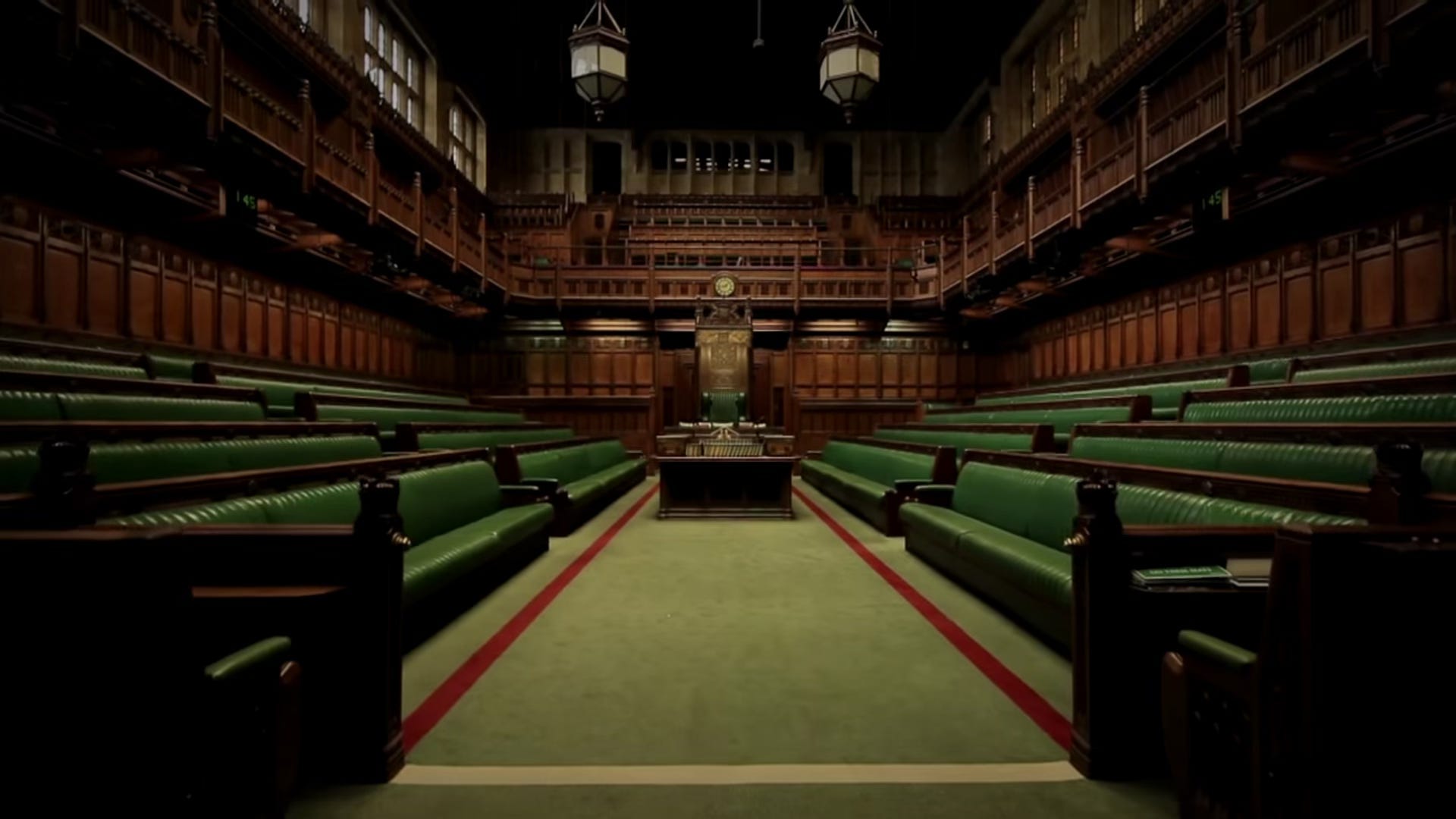
Image: UK Parliament chamber, via Wikimedia Commons (CC BY 3.0).
What Are We Fighting For?
This week, the head of Britain’s armed forces warned that there is a “growing risk” Russia could attack the UK, and that the nation’s “sons and daughters need to be ready to fight.”
This is an utterly extraordinary thing to say to a nation with whom the state has been eroding its side of the social contract.
A Crisis of Competence
I am beginning to think the Crisis of Competence in our establishment is worse than first thought. It’s not just that decisions are bad, it appears that there is no self-awareness and no basic common sense left anywhere near the centre of power.
A catalogue of failures in the past decades, they may have different origins and timelines, but they all point in the same direction: a steady decline of trust in the state’s competence and good faith:
Living standards declining
Quantitative easing redistributing wealth upwards on a scale few thought possible
Unaffordable housing
Fraying public services
Borders visibly unmanaged
Trust in state institutions at an all-time low
Sacrifice Without Trust
Now brought into sharp focus – defence spending, managed on the assumption that large-scale war was no longer possible. The armed forces reduced to a shadow of their former selves and now the news that “more families will know what sacrifice for our nation means.”
For what, exactly, and for whom?
We have just been told it is important to be honest with “families and households” about the need to prepare for “real, physical threats.” We are told that “sons and daughters. Colleagues. Veterans… will all have a role to play. To build. To serve. And if necessary, to fight.”
Firstly, this has been a very quick escalation from “the war will end soon” to “looks like there’s going to be a lot more war” but more importantly, this is serious language, a consequential message, but delivered from an establishment that has very low trust from the public and no legitimacy, no right to demand this from its people.
The message of war arrived without acknowledgement of failure, there was no effort to rebuild trust before asking for loyalty and sacrifice.
Perhaps in the high-trust society we once were this would have come across as realistic and measured, but in Britain in 2025 it comes across as arrogance.
Experience, Expertise and Exposure to Consequence
There is another problem here, a recurring theme in my writing.
Who, exactly, has the experience to speak this way?
Parliament is now dominated by a political class whose members increasingly arrive through think tanks, NGOs into special adviser roles with very little experience of a world outside Westminster. Similarly, the military has become more managerial and professionalised. The head of Britain’s armed forces has many years of experience with operational military matters, but no front-line combat experience of the kind he’s now asking the countries “sons and daughters” to prepare for.
This has come about partly due to the wars that Britain has chosen to fight, but it does matter.
We are entitled to ask whether anyone actually knows what they are asking for.
To be clear, it’s not the lack of technical expertise that is the problem here, but a lack of exposure to the consequences of action. It is easy for leaders to talk of children and families and sacrifice, while staying insulated from that reality. Historically, British leaders knew this. Nelson did not command from the back, he stood on the deck of the Victory in full view of the enemy, sharing the risk of the men he commanded and he was killed there. I’m not suggesting our leaders need to volunteer for active duty, but the imbalance here is hard to ignore.
The Ukraine Contradiction
It feels like there are contradictions running through all of this. Supporting Ukraine against Russian aggression is not the issue, it has wide support on moral and strategic grounds, but the logic of supporting Ukraine just enough to keep going and not lose is not a good strategy – it is attrition by proxy and invites cynicism about its purpose.
Large amounts of money have been spent, but industrial capacity has not been rebuilt, investment has not really increased, and we are told that the chance of Russia directly attacking the UK is “remote,” maybe 5%.
All of this indicates that our leaders really believe that the risk is low, which makes this rhetoric jarring. Any nation can tolerate danger and sacrifice in the right circumstances, but danger and sacrifice without honesty is another chip away at the social contract.
Hyperreality and the Desert of the Real
There is a French philosopher called Jean Baudrillard who will be another recurring theme in my writing. He has a concept called “Hyperreality” in which he warned that modern societies increasingly replace reality with representations of reality that feel real enough to organise behaviour or justify authority, but, over time the representations cease to point to anything solid underneath them, they become the reality, its endpoint (where the underlying reality is no longer needed) he called “the desert of the real”
This is where we are now.
The rhetoric does not match the underlying conditions, podcast war games simulate national collapse, strategic language simulates mobilisation, speeches simulate solidarity. (and once you see this, you can see it everywhere).
The simulation continues because admitting the absence of reality would expose the emptiness underneath.
When the defence chief cites media simulations as a way to “raise awareness,” it is not reassurance. The nation wants to see its leaders act like leaders, and if they believe war is coming, act like it.
The Reality
This is not war readiness. It is theatre.
The public are not stupid. They understand that the world is dangerous. What they no longer accept is being asked to pay the highest price by institutions that have yet to understand their own failures, or with the loss of trust that those failures produced.