


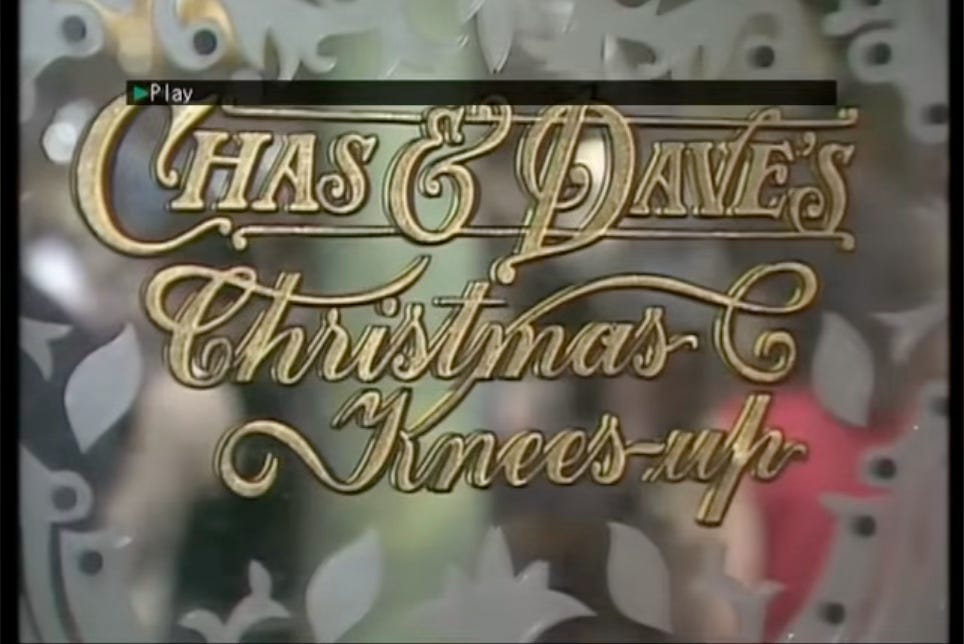
Frame from Chas & Dave’s Christmas Knees-Up (Thames Television, broadcast 25 Dec 1982) Source: YouTube — ChasNDaveVideos, accessed 6 Dec 2025.
I love country music, I’ve always loved country music. My earliest memories are of Tammy Wynette or Johnny Cash on the record player on a Sunday afternoon, watching my mum and dad singing in the kitchen. I also loved Chas & Dave and Lonnie Donegan and Jethro Tull, and I still do, but I’ve often wondered why country music is going through another revival and selling out the Albert Hall with Luke Combs and Darius Rucker, while I’m still watching Chas & Dave’s Cockney Christmas Knees Up on a grainy YouTube video every Christmas. That gig, in a pub, features one of the best country guitarists to ever have played, Albert Lee (from Birmingham), and the best blues guitarist who ever lived (come at me, I’ll die on this hill), Eric Clapton (from Guildford). It was recorded in 1982, forty-three years ago, yet American artists are selling out the Albert Hall in 2025.
What happened? Where is our country music? Surely a country that’s thousands of years old, with a history as rich and varied as ours and with the hardships our working class has had to bear, should have the best country music in the world.
So what is country music? The answer depends on who you ask, and even that may change with the time of day or the amount of whisky drunk, but for my purpose the cliché will do: three chords and the truth. Country music at its heart is simple, honest and rooted in the experiences of working people. Musically it normally features a guitar, a banjo or a mandolin, and the percussion often comes from the strings themselves. There are fiddles everywhere.
The country music that came alive in America has its roots in the British Isles. Many of the songs, instruments and styles that became country music crossed the Atlantic with British and Irish settlers in the 1700s and 1800s.
I first heard the song ‘Barbara Allen’ on an album by Billie Joe Armstrong and Norah Jones in 2013. What I didn’t realise at the time was that the song was first mentioned in Samuel Pepys’s diary in 1666, at the time of the Great Fire of London. It crossed the Atlantic and was rediscovered in Appalachia in the early 1900s. From there it became a cornerstone of Anglo-American balladry, absorbed into early country repertoires and recorded by Dolly Parton and Bob Dylan alongside Armstrong and Jones and many others.
Similarly, I knew Scarborough Fair, made famous by Simon and Garfunkel, was an old folk song, but not that it began life in the Middle Ages. Along with Barbara Allen, versions were found by collectors like Cecil Sharp in the Appalachian Mountains in the early 1900s.
Settlers also carried their instruments, most notably the violin, or fiddle. Developed in northern Italy around 1550 and spread to the British Isles by the 1600s, it became the heart of rural dance music in England, Scotland and Ireland. Ulster Scots and English migration carried fiddling to North America, and by 1800 it was central to Appalachian life. Tunes like Soldier’s Joy and Fisher’s Hornpipe, both born in Britain, became American standards.
Even some of the rhythmic motifs of country music came from these shores. Listen for the bass that rocks like a boat: low note, fifth, back again. You can hear it in Welsh and Irish harp tunes long before the boom-chicka of Johnny Cash. I’ve kept one harp track on the playlist so you can hear the family resemblance.
So the bones of country music are Anglo-Celtic in nature. We were its early pioneers. We are country music. Which leaves the question: what happened back here?
Well, and this will probably not come as a complete shock to anyone British, I think we got embarrassed about who we are. We stopped believing our own lives were worth singing about. The emotional vocabulary of home, faith and belonging became unfashionable. Country requires sincerity, but we abandoned all that to become ironic, sarcastic cynics.
I’m not saying that this is the only reason for our lack of mainstream voices from the heartlands. Industry and demography matter. The United States kept a commercial infrastructure for plain-spoken music that Britain never built at scale: radio formats, church and hymn traditions, rural touring circuits. Migration and media economics shaped what reached the mainstream. I’m also not saying British music fell silent; it evolved, punk, Britpop, grime. Authentic in their own registers, authentically British, but my claim is narrower: the emotional vocabulary that country keeps in the mainstream - home, place, belonging, faith - was pushed to the margins here. When that does appear in Britain, it shows up as niche or irony, not centre-stage.
We did not run out of stories; we learned to flinch from telling them. Orwell saw the beginnings of this. In The Lion and the Unicorn he wrote that “England is perhaps the only great country whose intellectuals are ashamed of their own nationality.” In those rooms irony and sarcasm pushed out feeling, and patriotism sounded vulgar.
That tone did not stay put. The places that set our taste, the private schools, publishers, newspapers and the BBC taught it to the rest of us. Recently John Humphrys has written that, for years, the BBC’s output reflected an educated, liberal world view, with working-class voices often marginalised and trust lower among poorer audiences.
As it spread, the middle class stopped being embarrassed about England and started being embarrassed for the English: the pubs, the flags, the sentiment, the unfashionable sincerity of it all.
The working class absorbed it. Bit by bit they learned to see their own culture the way the tastemakers saw it, as something to be ashamed of, something to grow out of. People kept their pride at home while learning to hide it in public. That tension made the old songs feel out of place.
The old songs faded from the centre. We imported our folk feeling from America, where the vocabulary of home and faith never went out of fashion. There were holdouts: Fairport Convention, Steeleye Span, village sessions that never died. But they were niche. Chas & Dave, for all their working-class understanding, were treated as a novelty. Morris dancers and wassailers became quaint, rolled out for village fetes.
Billy Bragg is the exception that proves the rule, a Barking voice carried by protest and folk-punk. The appetite survived; the permission often needed a cause.
The desire never left us though, American country artists tour here more and more and in late September 2025 the Grand Ole Opry took over the Royal Albert Hall and the place roared. Luke Combs brought out Marcus Mumford and led a room of Londoners through songs about love, loss, longing and home. For a moment you could feel the river running both ways. The appetite is not the problem, the permission is. We reach for American songs because they never stopped speaking plainly, from the heart. Nashville has its machinery and its polish, of course. It can be as calculating as any scene. But it never abandoned the hunch that ordinary lives and plain speech are worth celebrating, even when packaged for the mass market.
We had felt that place before. Chas & Dave’s Cockney Christmas Knees Up, filmed in 1982, could mark the end of unapologetic authenticity, the last moment we were not embarrassed by who we are. The set list ran through ‘Rabbit’ and ‘London Girls’, a simple hymn to our own, and brought on Lenny Peters, who sang about Jesus without a wink while the crowd swayed and joined in. Clapton, Lee and Chas & Dave’s ‘Goodnight Irene’ was a pub singalong across generations. I am not sure we would even allow it now; we take ourselves far too seriously. The closer, ‘If I Could Write a Love Song’, was tender and unguarded, and the room met it the same way.
For a long time we forgot what that room felt like. The pandemic offered a glimpse of what we had lost, during lockdowns people rediscovered sea shanties, kitchen-table concerts, and songs that spoke to shared experience rather than individual aspiration. For a moment, sincerity didn’t feel naive; it felt necessary, proof that simple songs about work and weather still move people. The crowd still answers when the voice is local. Nathan Evans, a former postman and ironworker filled our homes with those shanties during Covid, Gerry Cinnamon fills stadiums with a plain Glasgow voice and crowd-made momentum. Sam Fender carries brass band and pit-town feeling, singing about council houses and grassroots football onto the biggest stages. Whenever we sing in our own accent, audiences answer.
The desire is here; the stories are here. What we lost was the nerve to sing them in our own voice. We can take it back any time we like. Write the songs about terraces and allotments, mills and markets and about call centres, childcare and the night bus. Drive the Ticketmasters from the temple, stop treating sincerity as a guilty pleasure. The stories haven’t disappeared; we’ve just convinced ourselves they aren’t worth the telling. Let the voice of this country grow loud again.
Playlist
Here’s a companion playlist for the essay - a whistle-stop tour from old English/Welsh ballads and dance tunes that seeded American country, through Appalachian standards and Cash’s boom-chicka, to modern flashes of unembarrassed, local voice.
Billie Joe Armstrong & Norah Jones - “Barbara Allen”
Pepys-era ballad that crossed to Appalachia; Exhibit A for our shared songbook.Martin Carthy - “Scarborough Fair”
Medieval English ballad in its home accent; the root before Simon & Garfunkel.Robin Huw Bowen - “Ar Hyd y Nos”
Welsh harp tune; hear the rocking bass (root-fifth-root) that underpins country rhythm.The Watersons - “Country Life”
English rural chorus singing - work, seasons, community - without irony.Jean Ritchie - “The Cuckoo”
Anglo-American ballad preserved in the mountains; the folk line intact.The Carter Family - “Wildwood Flower”
Bedrock of early country; British-Isles melody reframed in Virginia.The Sharp Flatpickers - “Fisher’s Hornpipe / Whiskey Before Breakfast”
British dance tune into American fiddle standard - roots and afterlife in one cut.Bill Monroe & The Blue Grass Boys - “Uncle Pen”
Bluegrass cornerstone honouring the fiddler who carried the old tunes on.Ralph Stanley - “O Death”
Stark Appalachian spirituality; the plain voice laid bare, with echoes of English balladry.Johnny Cash - “I Walk the Line”
The alternating-bass “boom-chicka” no one did it better.Chas & Dave - “London Girls”
Unapologetically local, pub-room affection - authentic English vernacular.Nathan Evans - “Wellerman”
The lockdown shanty revival; proof the crowd still answers to work-songs.Gerry Cinnamon - “Sometimes”
Stadium singalong from a plain Glasgow voice; sincerity and honesty.Sam Fender - “Remember My Name”
Modern North-East storytelling (colliery-band DNA in his world); people, place and pride back on big stages.