


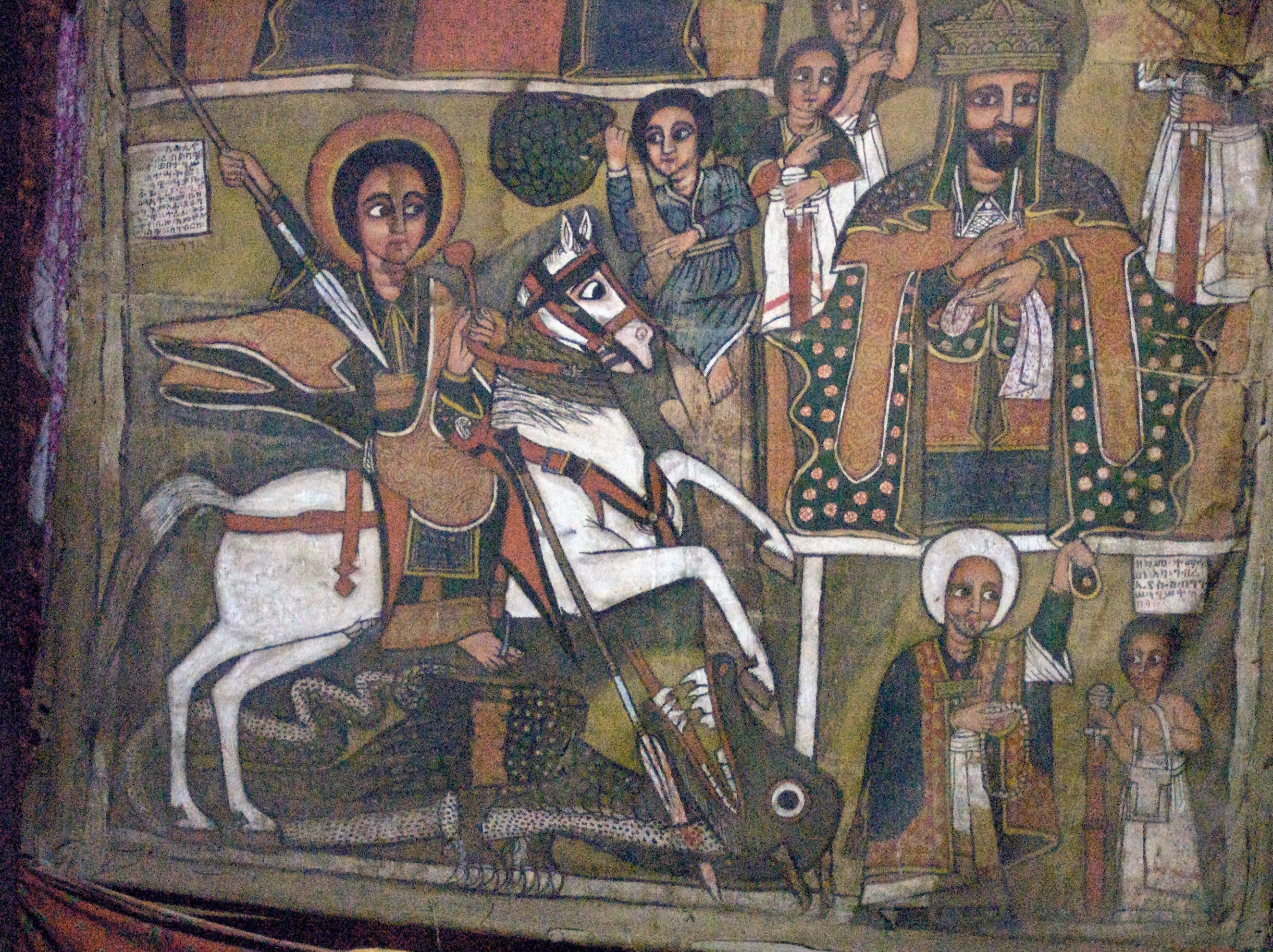
Henry: Cry ‘God for Harry, England, and Saint George!
Exeter: “Ah, sorry, Henry, just a minute, did you know that Saint George wasn’t actually English”
Henry “What? It’s a battle man, what are you talking about? The enemy are over there and I need to get these heathens to fight”
Exeter “Yes, I know, but he never even came to England, I think he was Turkish “
He Wasn’t Even English
The ‘he wasn’t even English’ argument runs every April 23rd without fail. George was Cappadocian, born in modern-day Turkey, and as a saint is shared with Georgia, Ethiopia, Portugal and about a dozen others.
I wonder how many Ethiopians spend April 23rd shouting ‘he wasn’t even Ethiopian’ at each other? Well, the thing about Ethiopia is that they celebrate him every single month, and they use the Ge’ez calendar which has 13 of them, which, by any reckoning would be a miserable way to spend your time.
A quick look at the saints of the British Isles:
St George: Turkish
St Patrick: British, kidnapped and TAKEN to Ireland
St Andrew: Galilee - never went to Scotland
St David: Genuinely as Welsh as the Valleys
So, one out of four.
Hands up who’s up for a trip to Ireland next March 17th to tell them? Or Scotland? November 30th, we can all get a coach up and stand in a Loch and tell them how silly they are.
Symbols
The thing about saints though, is that they’re symbols, not to be taken literally. They take on aspects of the culture and its people. Every culture projects onto them what it needs to see, and it appears that what we need to see, currently, is deep division and arguing.
What we should see is the Dragon and how many times we, the English have slain it. However, if no one knows what has been achieved, what values drove this country, what George and the Dragon represent, it’s going to be tough to rally around once more, so here’s three.
Land
In 1649, Gerrard Winstanley led a group of men onto common ground in Surrey, turned it over, and planted vegetables, and made the first attempt at an allotment. It lasted a few months before the army dispersed them, although they lost that battle, the war went on.
The day after St George’s Day 2026 is the 94th anniversary of the Kinder Scout mass trespass. On the 24th April 1932, five hundred ramblers walked onto Peak District moorland and refused to walk off.
The land they were walking on, they were told, was not theirs to walk on, it was used for grouse shooting. Previously common land, closed off to them for generations by landowners after the Enclosure Acts of the late 18th and early 19th Centuries.
The trespass began from Bowden Bridge quarry, the leader of the group, Benny Rothman gave a speech beforehand, telling the assembled ramblers that the land belonged to the people and they had every right to walk on it.
By the end of the day, five people were arrested, then in the coming weeks convicted of riot and sentenced to time in prison. The convictions garnered sympathy in England and the trespass helped pave the way for ramblers and rights to the countryside, through the fights to preserve public footpaths, the National Parks Act and the Countryside and Rights of Way Act.
A quarter of England is still public or common land, but another quarter is owned by fewer than 1,200 people.
Plain Speech
Commonly associated with the north of England, the value of plain speech was once a pillar of the English code. Orwell’s essay on the English language, published in 1946, argues that obscure prose is a form of power: it conceals meaning from people who lack the vocabulary, and it lets its users avoid saying things directly.
The Quakers refusing honorifics in the 17th century, and the best journalism of the last hundred years, both demonstrate that saying what you mean is a form of respect for the person you’re saying it to.
The degradation of public language, the jargon, the long, rambling speeches with no content, the use of euphemism, half-truths and lies by omission is a political act. It happens because somebody benefits from the confusion.
Mutual Societies
In 1844, twenty-eight workers in Rochdale who couldn’t get food at fair prices built their own shop, ran it collectively, and distributed the surplus back to members. Within a decade there were hundreds of co-operative societies across the country.
Working men’s clubs, the friendly societies, the allotment associations: all examples of people getting together and organising what was needed when no one would give it to them. The NHS is formed in this vision, Bevan was brought up in Tredegar in Wales where the Tredegar Medical Aid Society was founded in 1890, there miners paid a small weekly contribution from their wages and got medical care in return.
Slaying the Dragons
These values: the claim that the land is a common treasury. The obligation to speak plainly. The preference for building something together over waiting to be given it. They were all held prisoner by dragons, hoarding land, hoarding meaning and hoarding surplus.
An English Honesty
How did we face these dragons? With a particularly English kind of honesty.
There has always been a melancholy to England, the rituals and stories, the songs and the poetry, the reverence for the dead and the sacrifices made, a quiet and sombre dignity.
At Samhain, families cleared the table and set a place for the dead, they welcomed them in to pay their respects and on Armistice Day we observe silence for those who fought and died for us - same thing, centuries apart.
From the long barrows to the colliery brass bands there is an underlying sadness, but it manifests itself in different ways, like the gallows humour that England turns to in dark times. Thomas More, climbing the steps to his execution in 1535, said to the Lieutenant of the Tower: “Help me up; I can shift for myself coming down.” and in a more light-hearted way it appears on the terraces and in pubs, refrains of “We’re shit and we know we are” ring out around the country.
Acknowledging the situation and its gravity is necessary in order to make these jokes.
Somewhere along the way we’ve replaced this honesty with the insistence that every ending contains a beginning, which sounds like wisdom, but it’s not.
When the factory closes, or the pub, or the youth club, and we bulldoze it and build flats and call it progress without acknowledging what's gone, that's a dragon we still need to slay.
Who and What Are We?
The question for April 23rd is not whether George had a bulldog tattoo or drank warm beer or cycled through the mists or played cricket, it is, what are England’s dragons now? Because if we can’t answer that it does not matter where George was born.
Image: A. Davey, St. George Slaying the Dragon, Church of Debre Sina, Lalibela, Ethiopia, CC BY 2.0, via Wikimedia Commons