


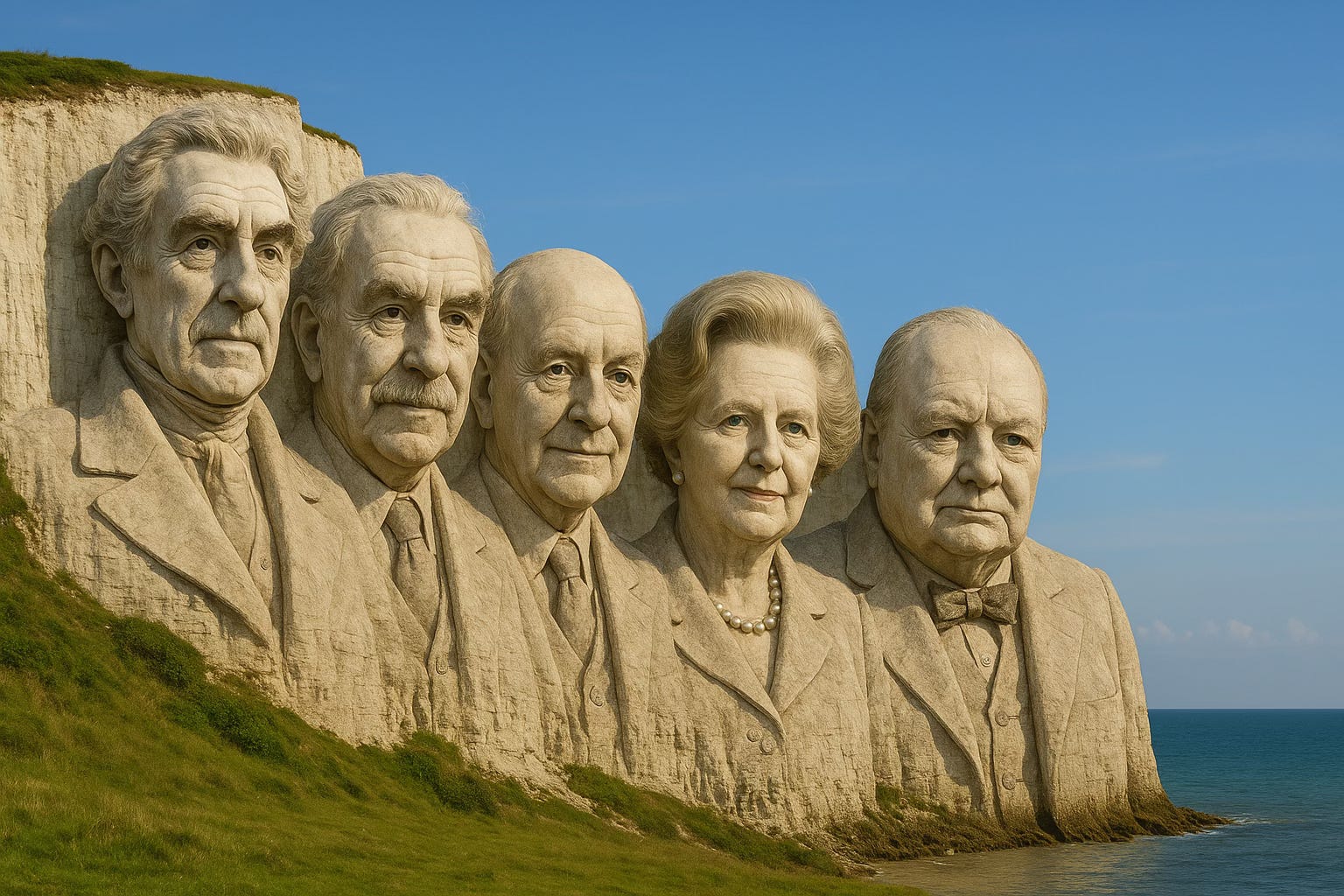
When Politics Meant Duty
From Wellington to Peel, from Gladstone and Disraeli through Attlee, Churchill, Macmillan, Healey and Thatcher, these were not perfect, but they were serious leaders. “The whole art of government,” wrote Wellington, “consists in being honest.” Whatever their differences, they shared a set of virtues: discipline, restraint, moral clarity, and a sense of duty that stretched beyond self or party. They upheld the ideals that once made the Western world strong, the old virtues of stoicism, service, and civic responsibility. They believed public office was not a performance, but a burden to be carried with honour.
What those figures all had in common was not just competence, but moral clarity, the ability to see what was right, to name it as such, and to act accordingly. Denis Healey once remarked, “The difference between a politician and a statesman is that a politician thinks about the next election; the statesman thinks about the next generation.” Our leaders of the past did not outsource their conscience to the crowd. Moral clarity doesn’t mean moral certainty, nor does it demand perfection; it means sticking to principles even when the crowd changes their mind. Our current crop of politicians appear to have lost their compass and because of this, their ability to lead.
What Changed?
Leadership comes through experience and perhaps the problem lies not only in what our politicians believe (or don’t), but in how they arrived in politics. Where once our leaders were captains of industry, public servants or those who served their country in the military, now we have a class of politicians of whom perhaps a third, maybe half, studied PPE at university. In the civil service (and we all know who’s running the show), less so, but still mostly humanities, very few from the hard sciences or engineering. In the 60s and 70s, around 75% of MPs had a full career outside in the real world before entering politics; now that number has dropped to around 40%, and among cabinet ministers this falls even further.
Of those who have had jobs outside of Westminster they are primarily in law, finance, banking or consultancy – the laptop class moving into the lanyard class.
Politics has always been dominated by the ‘posh’, privately educated, because they could afford to go into politics, and Thatcher’s first cabinet was reportedly around 95% privately educated. This fell through the 90s, rising again under Johnson. Starmer’s cabinet is the first cabinet almost entirely made up of state educated ministers, so as tempting as it is, we can’t blame the rich for the mess we’re in now.
The lack of life experience, the narrow funnelling of people through the same channels, regardless of whether they went to private or state school, is a huge problem for our country. For years we’ve had a national conversation about diversity but rarely have we discussed the complete lack of diversity within our political class. The PPE–banking–consultancy pipeline has produced a cohort of people who think alike, and who have no understanding of how anyone outside that world thinks.
The NPCs Are in Charge
The inability to grasp that letting hundreds of thousands of people into a country to boost GDP, when most of the electorate voted for precisely the opposite, should have been a massive red flag. But, like fish swimming in water, they have no sense of their surroundings. Even their language is niche and coded. Have you noticed how they don’t talk like real people? How they sound like robots, or NPCs (those characters in computer games that you can’t control), programmed to repeat certain phrases? “We’re building Britain.” “Levelling up means making sure no one is left behind.” “Tough on crime and the causes of crime.” “Hard-working families.” And my favourite, “Strong and stable leadership.” There are enough of these inane quotes to fill a book. This is not an accident; they actually think this works with people, because they know nothing else.
Go Team!
As the old line goes, politics is show business for ugly people. It’s a joke, but it’s gone further than that: it’s now a team sport for the kids who got picked last at PE. These automated, NPC phrases reveal something deeper, that the clarity and independence of thought we associate with great leadership has been replaced by blind tribal loyalty. The diversity of background may have changed, but the diversity of thought has all but disappeared.
And yet, it does provide the rest of us with some well-needed laughs. Cast your mind back:
• “Strong and stable leadership,” May used this by some counts around 140 times in interviews and it was repeated by almost every member of her party.
• “Get Brexit Done,” not only did this not happen, but even if it had, it’s not clear what it would have meant. Still, it echoed from every Conservative mouth in Britain.
• During Covid, there were repeated examples of identikit messages being tweeted out, in one instance from both Labour and the Tories, condemning and defending Dominic Cummings, sometimes in the exact same wording. Make of that what you will.
The Choreographed Press
This extends further than just the parties themselves, with ‘client journalists’ being briefed with lines or talking points and repeating them almost word-for-word in the press.
The Audience Joins In
Where this becomes truly dangerous is in how it bleeds into the public. People line up behind their chosen team and refuse to deviate, no matter what evidence lies before them. We’ve seen this play out most starkly in recent months over Middle Eastern politics. Moral outrage has replaced moral reasoning, and tribal identity has triumphed over truth.
The Crisis Beneath the Noise
The truth is that politics didn’t suddenly become shallow, everything else did first. We live in a feedback loop of outrage and affirmation, where every opinion must be liked, shared, and retweeted within minutes. The politicians just learned to play the same game. They speak in slogans because we reward slogans. We click for outrage and scroll past competence – we need to appreciate the dull, boring and safe again so that we can start to rebuild the confidence in our politics and our society.